The Southern Ocean is where much of the extra heat and carbon in the climate system goes into the ocean. The cold water that sinks around Antarctica is thinning, and sea ice has fallen to record lows since 2016. These are slow changes with global reach.
- What is it?
- The ocean circling Antarctica. It takes up a large share of the heat and carbon people add, and the water that sinks there fills and ventilates the deep ocean.
- How likely is it?
- Already under way: bottom water is thinning and its export has slowed in two basins; the IPCC expects the decline to continue (medium confidence). No tipping threshold has been estimated.
- What would it mean?
- Faster ice-shelf melt and sea-level rise, a possibly weaker ocean carbon sink that shrinks carbon budgets, and pressure on the krill at the base of the Antarctic food web.
- What can be done?
- Limit warming; protect Antarctic waters through the Antarctic treaty system; manage the krill fishery for a changing ocean; observe the deep ocean.
Observations, sea ice updated dailyReviewed 25 October 2026
What it is
What the Southern Ocean does
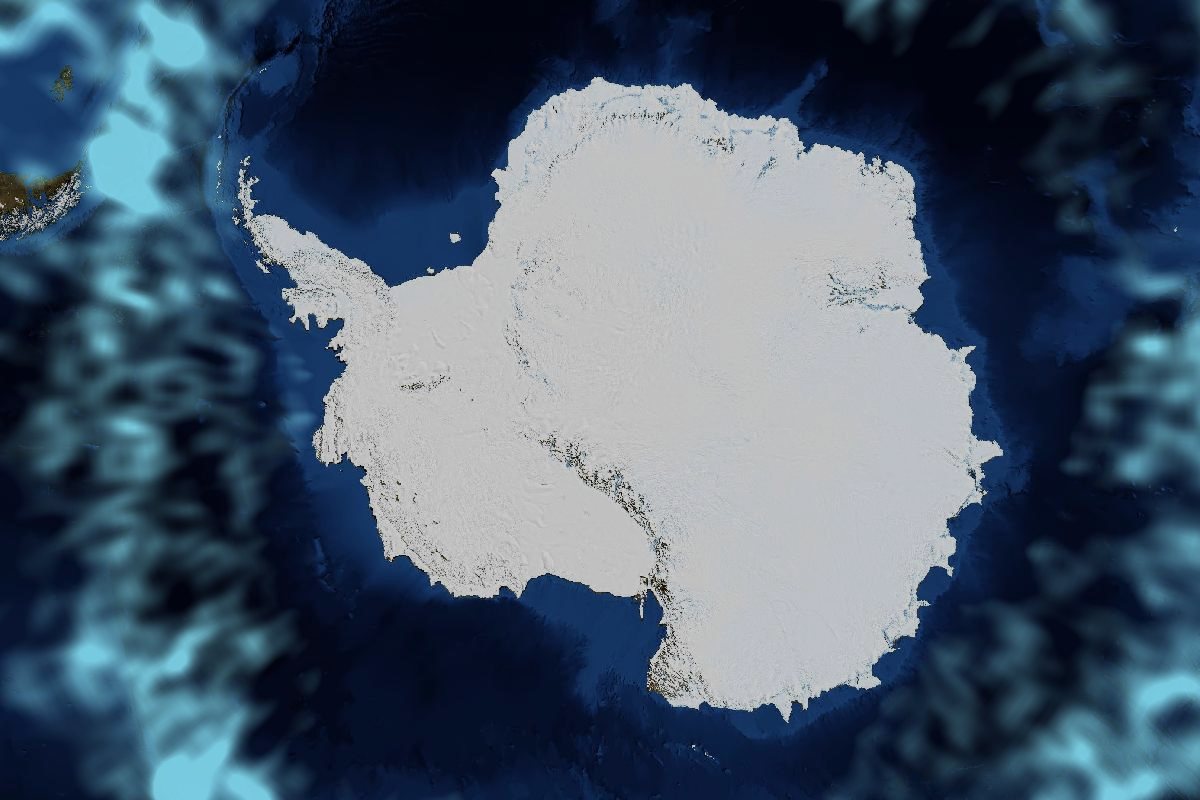
The Southern Ocean circles Antarctica and links the Atlantic, Indian and Pacific oceans. Deep water rises to the surface here, exchanges heat and carbon with the air, and moves north again. Around the Antarctic coast, freezing sea ice leaves salt behind, making the densest water in the ocean, which sinks to the sea floor as Antarctic Bottom Water and spreads north.
South of 30°S the ocean took up 35–43% of the heat gained by the world’s upper ocean in 1970–2017 (high confidence; Meredith et al., 2019). In models it took up about 43% of the carbon the ocean has absorbed from human emissions (Frölicher et al., 2015).
What we observe, and how likely
Observed changes and projections
Antarctic Bottom Water has warmed, freshened and thinned for decades (high confidence). Its export from the Australian Antarctic Basin fell by 4.0 million cubic metres a second between 1994 and 2009 before partly recovering (Gunn et al., 2023), and the volume of the densest bottom water in the Weddell Sea has fallen by about 30% since 1992 (Zhou et al., 2023).
The IPCC expects bottom-water formation to keep declining, with medium confidence; models point to meltwater from Antarctic ice shelves as the main driver (Li et al., 2023). The Global Tipping Points Report 2025 rates the Southern Ocean overturning as a tipping system with medium confidence, but no warming threshold has been estimated.
Antarctic sea ice rose slowly to a record high in 2014, then fell sharply, setting a record low in 2023. The 2026 winter maximum was the third lowest on record. Whether sea ice has shifted into a lasting new state is uncertain (Hobbs et al., 2024).
Antarctic: this year (red), last year (grey), the 1981–2010 median (dashed) and the lowest on record for each day (dotted).
Observed NSIDC Sea Ice Index, version 4. Updated daily.
What it would mean
Sea level, the carbon budget and the Antarctic food web
Sea level. As bottom water contracts, warmer deep water reaches the Antarctic continental shelf more easily, where it melts ice shelves from below (Li et al., 2023). That is the main way the West Antarctic ice sheet is losing ice. Ice sheets and sea level.
Carbon. The Southern Ocean’s carbon uptake weakened in the 1990s and recovered after 2000, variations that current models reproduce poorly (Gruber et al., 2019). A weaker sink would leave more carbon in the air and shrink the remaining carbon budget for everyone. In one model, a collapse of the Atlantic circulation releases carbon from the Southern Ocean, adding about 0.2°C of warming (Nian et al., 2026).
Krill and fisheries. Krill, the food of whales, seals and penguins, have contracted southward in the South Atlantic sector (Atkinson et al., 2019). The krill fishery reached its catch limit and closed early in both 2025 and 2026. Further afield, one model finds that nutrients trapped in the Southern Ocean could cut potential fish yields worldwide by more than 20% by 2300 under sustained high emissions (Moore et al., 2018).
What can be done
Emissions, protection and monitoring
Limit warming
Meltwater from ice shelves is the main projected driver, and ice-shelf melt follows ocean warming. A recent review finds that stabilising climate with minimal overshoot of 1.5°C is imperative (Abram et al., 2025). How much emissions must fall.
Protect Antarctic waters
The Ross Sea marine protected area, in force since 2017, covers 1.55 million km², 72% of it closed to commercial fishing. Proposals for East Antarctica, the Weddell Sea and the Antarctic Peninsula have not been agreed since 2016. Protection shields ecosystems from fishing; it cannot stop warming.
Manage krill for a changing ocean
Researchers propose catch limits that follow the krill stock and its variable recruitment, and restoring limits on where catches are taken (Meyer et al., 2025).
Observe the deep ocean
Standard Argo floats measure only the top 2,000 m. Deep floats, repeat ship sections and biogeochemical floats are needed to track bottom water and carbon. Ocean monitoring.
Which decisions should change
Act now
Long-lived, hard to reverse, and sensitive to the change: decide differently today.
- Keep mitigation ambition high and do not count on a stable ocean carbon sink in carbon-budget planning.
Assess now
High stakes but unclear answers: stress-test, monitor and set trigger points.
- Test how carbon budgets change if the Southern Ocean sink weakens, and how much Antarctica could add to high-end sea-level rise.
Stay the course
Pays off whatever happens, or is cheap to adjust later: keep going.
- Precautionary, ecosystem-based management of the krill fishery and protection of Antarctic waters.
The three decision types are Ocean Turning Points’ own lens, built on research on deciding under deep uncertainty. How to decide under uncertainty.
What this change means region by region and sector by sector
Sources
Meredith et al. (2019), IPCC Special Report on the Ocean and Cryosphere, Chapter 3; Frölicher et al. (2015), Journal of Climate 28; Gunn et al. (2023), Nature Climate Change 13; Zhou et al. (2023), Nature Climate Change 13; Li et al. (2023), Nature 615; Hobbs et al. (2024), Journal of Climate 37; Gruber et al. (2019), Annual Review of Marine Science 11; Nian et al. (2026), Communications Earth & Environment 7; Atkinson et al. (2019), Nature Climate Change 9; Moore et al. (2018), Science 359; Abram et al. (2025), Nature 644; Meyer et al. (2025), PNAS 122; Global Tipping Points Report 2025; IPCC AR6 Working Group I. Sea ice: NSIDC Sea Ice Index v4. Carbon uptake: MPI-SOM-FFN v2025, NOAA NCEI 0160558. Ross Sea MPA: CCAMLR Conservation Measure 91-05. Full evidence and references.